
Southern California’s Harvard-Westlake School is the first school to adopt SoyFoam™, a soy-based firefighting foam that provides high-performing fire suppression while addressing growing concerns about environmental and health impacts associated with traditional foams. The school is prepared to extinguish fires with SoyFoam and protect people and property by using a portable trailer-mounted sprinkler system that will allow school staff to blanket grounds, roofs and more with SoyFoam. Using SoyFoam may also require less total water volumes than repeated soakings with water alone.

The school’s decision reflects a proactive approach to enhance campus safety while reducing potential exposure risks for students, faculty, and staff.
“Adopting SoyFoam aligns with the ethos of our operations: prioritizing safety, embracing innovation, and upholding our responsibility to sustainability,” said Harvard-Westlake Director of Operations, Jeff Gin. “It allows us to respond effectively without worrying about runoff impacting the surrounding watershed.”
Californians Tyler Grasmick and Chris Figureida are the team behind this innovative school collaboration as well as inventors of the portable trailer-mounted sprinkler system known as the Skyline Sprinkler. Grasmick is a volunteer community brigade firefighter who first learned about SoyFoam when he researched product options at the National Fire Protection Association Conference & Expo, one of the fire protection industry’s leading gatherings. Following further evaluation of certifications, testing data, and performance results, he determined SoyFoam was the leading option among Class A and Class B firefighting foams. He believed in the product so much that he and Figureida wanted to introduce the product to their beloved home state.

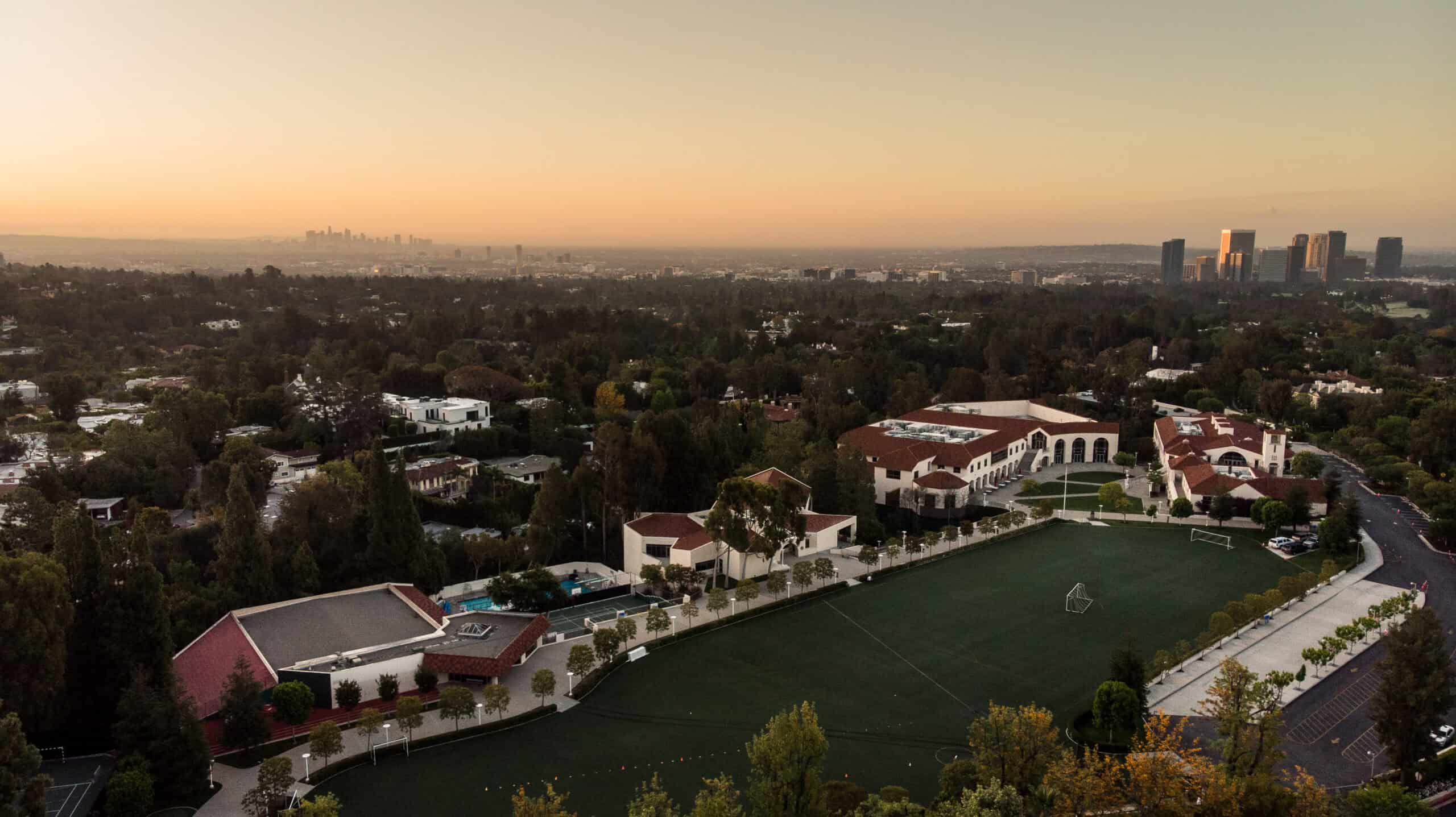
The Harvard-Westlake High School Campus, photo courtesy of Harvard-Westlake School
“As developers, sellers, and users of firefighting products, it was imperative that we find a solution for our customers and ourselves that was effective and, more importantly, safe. SoyFoam checked all our boxes for containment of Class A and B fires while protecting the environment and personal health,” says Figureida. “Supporting U.S. farmers through soy-based technology was an added benefit.”
“Through their Soy Checkoff, U.S. soybean farmers have supported the research to bring SoyFoam to the market as an innovative new use for our sustainably grown crop,” said United Soybean Board Director and soybean farmer, Greg Greving, who is also a former firefighter. “Like many farmers, I volunteered as a firefighter so the benefits of SoyFoam are very real to me for people and their communities. I am very excited to see this innovation come to California where it can help protect school children and more.”
California is phasing out PFAS-based Class B foams while transitioning to fluorine-free alternatives. SoyFoam suppresses both Class A (solid combustibles like wood, paper, cloth, and trash) as well as Class B fires (flammable liquids and gases, such as gasoline, oil, paints and propane).
Harvard-Westlake School administrators were increasingly concerned about wildfires as well as the use of firefighting foams with ingredients that might cause cancer on campus. With a large student population and an active campus environment, leadership wanted to ensure that any fire protection measures would not introduce additional hazards.
At the same time, growing wildfire risks across California reinforced the need for solutions. Protecting buildings, athletic fields, and surrounding property became an equally important consideration alongside health and environmental safety.
Working with fire protection professionals, the school explored available options in the firefighting foam market. After reviewing several alternatives, SoyFoam emerged as the preferred solution due to its strong performance and its biobased, PFAS-free formulation made from U.S. Soy.
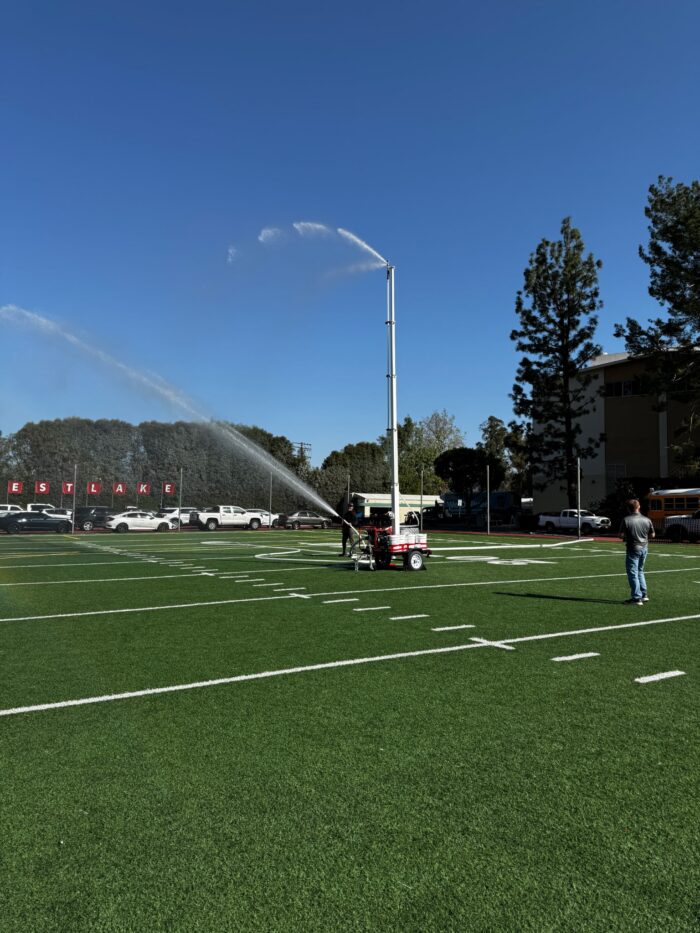
The Skyline Sprinkler, equipped with SoyFoam, on Harvard-Westlake’s field
Innovative Equipment: The Skyline Sprinkler
To support fire protection and emergency response capabilities, the school is prepared to deploy the portable trailer-mounted sprinkler system, Skyline Sprinkler. Originally designed for wildland structure protection, the system has evolved into a versatile tool for use across firefighting, agriculture, and construction sectors. This flexible setup allows emergency responders to protect structures, soak surrounding areas, and deploy foam quickly when needed. SoyFoam’s ability to create a foam blanket could also allow fire fighters to reduce their use of water, a key concern in California.
Key capabilities include:
- A telescoping mast sprinkler capable of soaking large areas or structures to increase humidity and reduce fire risk.
- Adjustable spray coverage up to 200 feet with flow rates ranging from approximately 25 to more than 120 gallons per minute.
- Onboard foam eduction with capacity to carry up to 15 gallons of SoyFoam, allowing foam and water to be deployed simultaneously.
- Dual 1.5-inch hose connections for direct fire suppression while the sprinkler provides indirect area coverage.
- A powerful Multiquip pump system that enables the unit to draft water from natural sources or connect directly to hydrants.
- Enclosed trailer storage capable of carrying hundreds of feet of hose, with the ability to detach and operate as a stationary sprinkler system.
Harvard-Westlake’s decision highlights the growing interest in safer, more sustainable firefighting technologies. In regions like California, where wildfire risk continues to rise, this approach demonstrates how institutions can take proactive steps to protect not only people and the environment, but also critical infrastructure and property. As organizations across the country evaluate alternatives to conventional foams, this school’s adoption shows how biobased innovations can deliver comprehensive protection on all fronts.
SoyFoam™ TF-1122 meets the four burn requirements for Class A and Class B fire extinguishments in accordance to NFPA 18 standard on wetting agents. It contains no detectable fluorines (less than 1 part per billion) in the foam concentrate. SoyFoam is the only GreenScreen Certified Gold™ firefighting foam in the World and is the only foam made from our very own US Farmer soybeans. SoyFoam™ is also certified readily biodegradable by the Organization for Economic Cooperation and Development (OECD) and 84% biobased through the USDA’s BioPreferred® Program. Although SoyFoam has been observed to exhibit potential fire-retardant behavior, there is no scientific testing, independent verification, or certification confirming its effectiveness, safety, or suitability as a fire-prevention foam. As a fire retardant, this product has not been tested, evaluated, approved, or certified by any regulatory or standards agency (including UL, NFPA, ASTM, EPA or similar organizations).